Which of the Following Is True About the Arts and Basic Education?
 | |
| Ministry of Education, Civilisation, Research, and Technology Ministry of Religious Affairs | |
|---|---|
| Minister of Instruction, Culture, Enquiry, and Technology Government minister of Religious Affairs | Nadiem Makarim Yaqut Cholil Qoumas |
| National pedagogy budget (2017) | |
| Budget | IDR 416.1 trillion USD 31.2 billion |
| General details | |
| Primary languages | Indonesian |
| System type | Curriculum |
| Competency-based curriculum | 14 Oct 2004 |
| Literacy (2018) | |
| Total | 95.66%[1] |
| Male person | 97.33%[1] |
| Female | 93.99%[ane] |
| Enrollment (2018) | |
| Total | (Northward/A) |
| Main | 93.5%[1] |
| Secondary | 78.73%[i] |
| Post secondary | 36.31%[1] |

Students wearing the pramuka (sentinel) uniform studying. This uniform is usually worn on either Wed, Friday or Saturday.

The students pictured in a higher place are listening to a guide at the Trowulan Museum, East Java whilst examining a model of the Jawi temple.
Education in Indonesia falls nether the responsibility of the Ministry building of Education, Culture, Research, and Technology (Kementerian Pendidikan, Kebudayaan, Riset, dan Teknologi or Kemdikbudristek) and the Ministry building of Religious Affairs (Kementerian Agama or Kemenag). In Indonesia, all citizens must undertake twelve years of compulsory education which consists of half dozen years at elementary level and three each at middle and high school levels. Islamic, Christian, and Catholic Schools are under the responsibility of the Ministry building of Religious Affairs.
It is important to understand what the government in Indonesia is doing to ensure that all citizens accept a correct to education. One such organization that measures this is the Human Rights Measurement Initiative. The Indonesian government is just doing 83.2% of what is possible at its income level, categorizing the authorities's ability to fulfil the right equally "bad". To look at this statistic in depth, we can consider primary and secondary school enrolment. For primary school enrolment, Indonesia is doing simply 85.2% for what is possible at its income level, and 81.three% for secondary school enrolment.[2] This data reveals that Indonesia could be making better use of its income to ensure that education in the country is good.
Pedagogy is defined as a planned endeavor to establish a report surroundings and educational process and so that the student may actively develop his/her own potential in religious and spiritual level, consciousness, personality, intelligence, behaviour and inventiveness to him/herself, other citizens and the nation. The Constitution likewise notes that at that place are two types of instruction in Republic of indonesia: formal and non-formal. Formal education is farther divided into iii levels: primary, secondary and tertiary instruction.
Schools in Republic of indonesia are run either by the government (negeri) or private sectors (swasta). Some private schools refer to themselves as "national plus schools" which means that their curriculum exceeds requirements set past the Ministry of Education, especially with the use of English as medium of instruction or having an international-based curriculum instead of the national i. In Indonesia there are approximately 170,000 principal schools, 40,000 inferior-secondary schools and 26,000 high schools. 84 percentage of these schools are under the Ministry building of Education and Culture and the remaining xvi percent under the Ministry of Religious Diplomacy.
History [edit]
Era of Islamic states [edit]
The emergence of Islamic country in Indonesia is noted by the acculturation of Islamic and Hindu-Buddhist traditions. At this time, pondok pesantren, a type of Islamic boarding school was introduced and several of them were established. The location of pesantren is mostly faraway from the hustling crowd of the city, resembling the location of Karsyan.
Colonial era [edit]
Elementary instruction was introduced by the Dutch in Indonesia during the colonial era. The Dutch didactics system are query strings of educational branches that were based on social status of the colony's population, with the best available institution reserved for the European population.
In 1870, with the growth of Dutch Ethical Policy formulated past Conrad Theodor van Deventer, some of these Dutch-founded schools opened the doors for pribumi (lit. native Indonesians). They were called Sekolah Rakjat (lit. folk school), the embryo of what is called Sekolah Dasar (lit. elementary school) today.[3] In 1871 the Dutch parliament adopted a new education law that sought to uniform the highly scattered and diversified indigenous education systems across the archipelago, and expand the number of teacher preparation schools under the supervision of the colonial administration. The budget for public schooling was raised in steps from ca. 300,000 guilders in 1864 to roughly 3 1000000 guilders by the early 1890s. Most oftentimes, however, the didactics development were starved of funding, considering many Dutch politicians feared expanding didactics would eventually lead to anti-colonial sentiment.[4] Funding for education only counted for 6% of the full expenditure of the colonial budget in the 1920s. The number of authorities and private main schools for natives had increased to 3,108 and the libraries to three,000 by 1930.[5] Still, spending sharply declined after the economic low in 1930.[iv]
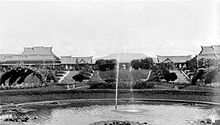
The Dutch introduced a system of formal educational activity for the local population of Republic of indonesia, although this was restricted to certain privileged children. The schools for the European were modeled afterwards the didactics organisation in Netherlands itself and required proficiency in Dutch. The Dutch language was also needed for higher education enrollment. The elite native/Chinese population who lack Dutch language skills could enroll in either Dutch Native or Chinese schools. The schools were bundled in the post-obit levels:
- ELS (Dutch: Europeesche Lagereschool lit. "European Depression School") – master school for Europeans
- HSS (Dutch: Hollandsch-Schakelschool lit. "Dutch-Switch School")
- HIS (Dutch: Hollandsch-Inlandscheschool lit. "Dutch-Native School") – main schoolhouse for natives
- HCS (Dutch: Hollandsch-Chinescheschool lit. "Dutch-Chinese School") - primary schoolhouse for Chinese
- MULO (Dutch: Meer Uitgebreid Lager Onderwijs lit. "More than Advanced Low Teaching") – eye school
- AMS (Dutch: Algemene Middelbareschool lit. "General Center School") – loftier school or college
- HBS (Dutch: Hogere Burgerschool lit. "Higher Denizen School") – pre-academy

Neutrale Lagere School in Malang.
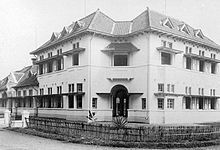

Inside a classroom of Dutch Native Schoolhouse in Bandung.
For the population in rural areas, the Dutch created the Desa Schools or hamlet schools system which aimed to spread literacy among the native population. These schools provide two or three years training of vernacular subjects (reading, writing, ciphering, hygiene, animals and plants, etc.) and served as cheaper alternative schools. These village schools, however, received much less funding than the privileged European schools, thus the quality of education provided is frequently lacking. Despite its flaws, the number of village schools reached 17,695 by 1930.[5] The remainder of the rural instruction were left to the work of Christian missionary, which are considered more cost-efficient.[v] [6]
The segregation between Dutch and Indonesian in education pushed several Indonesian figures to start educational institutions for local people. Arab Indonesians founded Jamiat Kheir in 1905, Ahmad Dahlan founded Muhammadiyah in November 1912, and Ki Hajar Dewantara founded Taman Siswa in July 1922 to emancipate the native population. Pesantrens (Islamic schools) were also mushrooming rapidly during this period.[7]
During the colonial period at that place was a big gap between the educated male person and female population. In 1920, on the island of Coffee and Madura out of the half dozen.5% literate male population, only 0.5% of the female native population are literate. Similar miracle can exist observed on the 'Foreign Orientals' (Arabs and Chinese), with 26.v% literate male population and only 8.v% literate females out of the total population. In the outer islands beyond Coffee the departure betwixt literate male and female population are 12% and 3% out of the population respectively.[five] Inspired by a Javanese-born blueblood Kartini who died young at the age of 25, the Van Deventer family worked to increase female person involvement in teaching and received support from the Dutch government — eventually leading to foundation of Kartini Schools in 1911.[5]
The Dutch colonial government established universities and colleges for native Indonesian on the island of Java. Earlier founding the Bandung Institute of Technology in 1920, there was no academy-level educational activity in the country; students had to go away (mainly to Netherlands) to receive it. About of these universities take become the country's top educational institution as of today. These institutions are as follow:[8]
- Schoolhouse tot Opleiding van Inlandsche Artsen or STOVIA, a medical academy which later go Geneeskundige Hogeschool in Batavia.
- Nederland-Indische Artsen School or NIAS, a medical school in Soerabaja.
- Rechts-Hoge-School, a law school in Weltevreden, Batavia.
- De Technische Hoge-School, or THS, a technic schoolhouse in Bandoeng and the first full-fledged academy in the country (opened in 1920).
- Middelbare Landbouw-school, an agriculture college which later become Landbouwkundige Faculteit in Buitenzorg
- Opleiding-Schoolhouse voor Inlandsche Ambtenaren or OSVIA, colleges for grooming native civil servants.
- Hollandsche-Indische Kweek-school, colleges for training teachers.
By the 1930s, the Dutch had introduced limited formal education to nearly every province of the Dutch E Indies, although by this period only vii.iv% of the population were literate in 1931[9] and 2% were fluent in Dutch. Around the outer islands beyond Java, to see demand of schooling, the Dutch regime relied heavily on missionary schools that mostly provide bones and moral instruction.[five]
Japanese occupation [edit]
During the Japanese occupation in World War II, the operations of the Dutch didactics system were consolidated into a single functioning that parallel the Japanese educational activity system. The Japanese occupation marked the deterioration of education in Indonesia, as schools were organized with the goal of creating Greater Eastern asia Co-Prosperity Sphere of influence. As a upshot, schools began training in armed services and physical drill that were anti-West oriented. It included indoctrination of Japanese civilisation and history. Students were required to raise the Japanese flag and bow to the Emperor every morning. The Japanese made schools less stratified; despite this, enrollment had shrunk by 30% for primary education and 90% for secondary education by 1945.[6]
Post independence [edit]

A schoolhouse in Borneo for eradicating adult illiteracy, c. 1952
Under the Japanese and Dutch occupation, most of the educational institutions were created to support the needs of the occupying power. There were very few efforts to promote the intellectual advancement of the indigenous population. After Indonesia declared its independence in 1945, the surviving didactics system was frail and unorganized. In addition there was a shortage of teachers, as most of them had been Dutch or Japanese.[6] Very few Indonesians had experience in managing schools.
Eager to accost the fail of focused education on native population, the first regime of Indonesia had to create a system from scratch and reject the colonial European organisation. An Act declared in the 1945 constitution every bit Chapter 8, article 31, clause 1 that "every citizen has the right for education". The Ministry of Education, Instruction and Culture was founded with its first minister, Soewandi. The new institution sought to create an education that is anti-discriminatory, -elitist, and -capitalist to promote nationalism of the new republic of Republic of indonesia. Information technology was also decided that faith deserved a proper place and attention under the new republic, resulting in an increased back up for Pesantren and Islamic Madrasah.[6]
In 1961, 46.7% of the population were literate.[9]
Early on instruction [edit]
Pre-school pedagogy in Republic of indonesia is covered nether PAUD (Pendidikan Anak Usia Dini, lit. Early Historic period Educational activity) that covers Taman Bermain (playgroup) and Taman Kanak-Kanak (kindergarten, abbreviated TK). PAUD is nether direct supervision and coverage of Directorate of Early on Age Didactics Development (Direktorat Pengembangan Pendidikan Anak Usia Dini).
From the age of two, parents send their children to Taman Bermain. From the historic period of four, they nourish Taman Kanak-Kanak. Most TKs arrange the classes into ii grades: A and B, which are informally called kelas nol kecil (little zero form) and kelas nol besar (big zero grade) respectively. While this level of teaching is not compulsory, information technology is aimed to prepare children for primary schooling. Of the 49,000 kindergartens in Indonesia, 99.35% are privately operated.[10] The kindergarten years are normally divided into "Form A" and "Grade B" with students spending a yr in each course.
Public main and secondary education [edit]
Indonesians are required to nourish 12 years of school.[11] They must go to school six (or five, depending on the establishment) days a week from half-dozen:thirty a.one thousand. until afternoon (usually 2 or 3 p.one thousand.).[12] They can choose between land-run, nonsectarian public schools supervised by the Ministry of National Education (Kemdiknas) or private or semi-private religious (usually Islamic) schools supervised and financed by the Ministry of Religious Affairs.[12] Students can cull to participate in extracurricular activities provided by the school such every bit sports, arts, or religious studies.[12] Nevertheless, although 86.1 pct of the Indonesian population is registered as Muslim, according to the 2000 census only 15 percent of school-age individuals attended religious schools.[12] Overall enrollment figures are slightly higher for girls than boys and much college in Java than the rest of Indonesia.[12]
A cardinal goal of the national education system is to impart secular wisdom well-nigh the world and to instruct children in the principles of participation in the modernistic nation-country, its bureaucracies, and its moral and ideological foundations.[12] Kickoff under Guided Republic (1959–65) and strengthened in the New Gild after 1975, a key feature of the national curriculum — was the case for other national institutions — has been instruction in the Pancasila.[12] Children age vi and older learned past rote its five principles — belief in ane God, humanitarianism, national unity, commonwealth, and social justice — and were instructed daily to apply the meanings of this key national symbol to their lives.[12] Simply with the end of the New Gild in 1998 and the beginning of the entrada to decentralise the national regime, provincial and district-level administrators obtained increasing autonomy in determining the content of schooling, and Pancasila began to play a diminishing role in the curriculum.[12]
A style of instruction prevails inside public-schoolhouse classrooms that emphasises rote learning and deference to the authority of the instructor.[12] Although the youngest children are sometimes allowed to use their local linguistic communication, by the third year of master school near all education is conducted in Indonesian.[12] Teachers customarily practice not inquire questions of individual students; rather, a standard teaching technique is to narrate a historical upshot or to describe a mathematical trouble, pausing at primal junctures to allow the students to call out responses that "fill in the blanks".[12] By not identifying individual problems of students and retaining an emotionally distanced demeanor, teachers are said to evidence themselves to be patient, which is considered admirable.[12]
Children ages 6–12 nourish primary school, called Sekolah Dasar (SD).[12] As of 2014, near simple schools are government-operated public schools, accounting for 90.29% of all unproblematic schools in Indonesia.[xiii] Students spend vi years in principal schoolhouse, though some schools offer an accelerated learning programme in which students who perform well tin can complete the level in five years.[ citation needed ]
3 years of junior high school ( Sekolah Menengah Pertama , or SMP) follows unproblematic schoolhouse.[12] Some schools offer an accelerated learning program in which students who perform well tin complete the level in two years.
There are bookish and vocational junior high schools that lead to senior-level diplomas. In that location are also "domestic science" junior loftier schools for girls.[12]
Subsequently completion, they may exist attend three years of high school ( Sekolah Menengah Atas or SMA). Some loftier schools offer an accelerated learning program and then students who perform well tin complete their level in two years. Besides high school, students can choose among 47 programmes of vocational and pre-professional person high school ( Sekolah Menengah Kejuruan or SMK), divided in the following fields: technology and engineering, health, arts, arts and crafts and tourism, information and communication technologies, agro-business and agro-technology, business management. Each requires three years of study.[xiv] At the senior high school level, three-year agricultural, veterinary, and forestry schools are open to students who have graduated from an academic inferior high school.[12]
Special schools at the junior and senior levels teach hotel direction, legal clerking, plastic arts, and music.[12]
Students with disabilities/special needs may opt to be enrolled in a separate school from the mainstream chosen Sekolah Luar Biasa (SLB, lit. Extraordinary School).[15]
The Indonesian education organization is the 4th largest in the earth with more than 50 million students, iii million teachers, 300,000 schools.[xvi] Principal to loftier schoolhouse level is compulsory.[16] Primary and middle school is free, while in high school, there are small fees.[16] The completion rate for Indonesian chief schools is loftier.[16] In 2018, the cyberspace enrollment rate for primary, middle school, and high school each is 93.5%, 78.84%, and 60.67%.[17] [one] The tertiary-education participation is low at 36.31%.[ane] In 2011, the survival rate for principal, middle, and high school as the following numbers: 95.iii%, 97.68%, and 96.8%.[16] The college the percent of survival charge per unit means that fewer students at sure didactics level who drop out. Although the Indonesian government has accomplished significant improvement in teaching sector, in that location are even so many challenges that should be addressed, including funding, management, disinterestedness, and education quality.
Teacher-training programs are varied and gradually being upgraded. For instance, in the 1950s anyone completing a instructor-training program at the inferior high school level could obtain a teacher'south certificate.[12] Since the 1970s, however, primary-school teachers take been required to have graduated from a senior high school for teachers, and teachers of college grades have been required to have completed a academy-level instruction course.[12] Remuneration for chief- and secondary-school teachers, although low, compares favourably with that in other Asian countries such as Malaysia, Bharat, and Thailand.[12] The pupil–teacher ratio is 17 to 1 and 15.ii to one, respectively, for primary and secondary schools in 2018; that same yr, the overall averages for East asia & Pacific countries were 17.5 to 1 and 14.8 to one, respectively.[18] [19]
Past 2008, the staff shortage in Republic of indonesia's schools was no longer every bit astute every bit in the 1980s, but serious difficulties remain, peculiarly in the areas of instructor salaries, teacher certification, and finding qualified personnel.[12] In many remote areas of the outer islands, in particular, there is a severe shortage of qualified teachers, and some villages have schoolhouse buildings but no teachers, books, or supplies.[12] Providing textbooks and other school equipment to Republic of indonesia's 37 1000000 schoolchildren throughout the far-flung archipelago continues to be a meaning problem also, especially in more remote areas.[12]
School grades [edit]
The schoolhouse twelvemonth is divided into ii semesters. The first commences in July and ends in December while the latter commences in January and ends in June.
| Level/Grade | Typical age |
|---|---|
| Preschool | |
| Pre-schoolhouse playgroup | three-4 |
| Kindergarten | 4-half-dozen |
| Primary School | |
| 1st Form | vi–seven |
| 2nd Class | 7–eight |
| tertiary Grade | 8–9 |
| fourth Grade | 9–ten |
| 5th Form | ten–xi |
| sixth Form | 11–12 |
| Middle School | |
| seventh Grade | 12-thirteen |
| eighth Grade | 13-14 |
| 9th Course | 14-15 |
| Loftier Schoolhouse | |
| 10th Grade | xv–xvi |
| 11th Course | 16–17 |
| 12th Grade | 17–18 |
| Post-secondary education | |
| 3rd education (college or university) | Ages vary (usually 17–21 or 18–22 for iv years) |
| Graduate education | |
| Adult education | |
2013 curriculum [edit]
| Discipline | Subjects | Grade | |||||||||||||||
|---|---|---|---|---|---|---|---|---|---|---|---|---|---|---|---|---|---|
| # | Proper noun | # | Name | Primary school[twenty] | Center school[21] | High school[22] | |||||||||||
| 1 | two | 3 | 4 | v | half-dozen | seven | 8 | nine | 10 | 11 | 12 | ||||||
| one | Educational activity | 1 | Religion | 4 | 3 | 2 | |||||||||||
| 2 | Pancasila and civics | 6 | two | ||||||||||||||
| 3 | Physical education | 4 | two | ||||||||||||||
| 4 | Home economics | n/a | two | ||||||||||||||
| 2 | Language (and literature) | i | Indonesian language | 6 | 4 | ||||||||||||
| 2 | English linguistic communication | north/a | four | ||||||||||||||
| 3 | Natural sciences | 1 | Mathematics | six | iv | ||||||||||||
| ii | Physics | n/a | ane.5 | 2 | n/a | ||||||||||||
| 3 | Biology | ||||||||||||||||
| 4 | Social sciences | 1 | History | n/a | ane | 2 | |||||||||||
| 2 | Geography | n/a | |||||||||||||||
| iii | Economics | ||||||||||||||||
| 5 | Arts | one | Music | ane | 1 | ||||||||||||
| 2 | Painting | ||||||||||||||||
| 3 | Skill | due north/a | |||||||||||||||
| 4 | Trip the light fantastic toe | ||||||||||||||||
| 6 | N/A | ane | Peminatan Akademik | n/a | 2 | ||||||||||||
| two | Kelompok Peminatan | xvi | |||||||||||||||
| Total hours | 30 | 36 | 42 | ||||||||||||||
| Total subjects | six | 8 | x | 14 | |||||||||||||
- Specialization groups (kelompok peminatan)
| # | Natural sciences | Social sciences | Linguistic communication and literature | Islamic schools | Christian theology schools | Cosmic schools | Full hours |
|---|---|---|---|---|---|---|---|
| 1 | Mathematics | History | Indonesian linguistic communication | History of Islam | History of Christianity | History of Catholicism | iv |
| 2 | Physics | Geography | Anthropology | Tafsir | History of Church | Scripture | iv |
| three | Biology | Economics | Indonesian literature | Hadith | Bible | Catholic Church doctrine and Christian morals | 4 |
| 4 | Chemistry | Folklore | Strange language | Fiqh | Christian ethics | Liturgy | four |
Islamic schools [edit]

Students in the dorm of a school of higher Islamic pedagogy, Bukittinggi, c. 1953
There are three types of Islamic schools in Indonesia, pesantren, madrasah, and sekolah islam. Pesantren can exist pocket-sized with just a few teachers and students to quite large with dozens of teachers and hundreds of students. Pesantren are led by hereditary kiais, who lead the school and have religious authority. Madrasah vary in their ideological foundations and vary in the provision of secular and religious content. Sekolah Islam use the Ministry of Education and Culture's secular curriculum and add their ain Islamic curricula.[23]
The secular and nationalist emphasis in public schools has been resisted by some of the Muslim bulk.[12] A distinct and song minority of these Muslims adopt to place their children in a pesantren (Islamic boarding schoolhouse) or Islamic school.[12] Usually institute in rural areas and directed by a Muslim scholar, pesantren are attended by young people seeking a detailed understanding of the Quran, the Arabic language, sharia, and Muslim traditions and history, as well as more mod subjects such every bit English language, mathematics, and geography. Students can enter and leave the pesantren any time of the twelvemonth, and the studies are not organized equally a progression of courses leading to graduation.[12]
Although the chief aim of pesantren is to produce good Muslims, they exercise not share a single stance toward Islam or a position on secularism.[12] Some pesantren emphasise the autonomy of modern students to think for themselves and to translate scripture and modern noesis in a fashion that is consistent with the teachings of Islam.[12] Others are more traditional and stress the importance of following the wisdom of elders, including their teachings on science, religion, and family life.[12] Although the terrorist bombings in Kuta, Bali, in 2002 raised suspicions near whether pesantren promote extremist views, the majority of these schools in Republic of indonesia are theologically moderate, reflecting the views of the Indonesian population every bit a whole.[12] For those who opt for a pesantren education, a 6th-class equivalency certificate is available after successful completion of a country exam.[12]
For students to suit to life in the modern nation-state, in the 1970s the Muslim-dominated Department of Religion (at present the Section of Religious Affairs) advocated the spread of a newer variety of Muslim school: the madrassa.[12] This kind of schoolhouse integrates religious subjects from the pesantren with secular subjects from the Western-style public-instruction system.[12] Although in general the public believes that Islamic schools offer lower-quality pedagogy, amongst Islamic schools a madrassa is ranked lower than a pesantren.[12]
Madrasah Ibtidaiyah (MI) is the Islamic schooling alternative to SD, post-obit a curriculum with more than focus on Arabic and Islam. Madrasah Tsanawiyah (MTs) is the Islamic schooling equivalent of SMP. Madrasah Aliyah (MA) is the Islamic schooling equivalent of SMA while Madrasah Aliyah Kejuruan (MAK) is the equivalent of SMK.[ citation needed ]
Higher pedagogy [edit]
International education [edit]
As of January 2015, the International Schools Consultancy (ISC)[24] listed Indonesia as having 190 international schools.[25] ISC defines an 'international schoolhouse' in the following terms "ISC includes an international schoolhouse if the school delivers a curriculum to any combination of pre-school, primary or secondary students, wholly or partly in English outside an English-speaking country, or if a school in a state where English language is one of the official languages, offers an English language-medium curriculum other than the country'south national curriculum and is international in its orientation."[25] This definition is used past publications including The Economist.[26]
See also [edit]
- Indonesian National Academic Test
- Listing of schools in Indonesia
- List of universities in Indonesia
- List of Indonesian agricultural universities and colleges
References [edit]
- ^ a b c d eastward f chiliad h "Republic of indonesia". uis.unesco.org. 27 November 2016. Archived from the original on 21 August 2017. Retrieved 23 August 2020.
- ^ "Republic of indonesia". Human Rights Measurement Initiative Rights Tracker. Archived from the original on 18 November 2021. Retrieved 20 July 2021.
- ^ "Nicht verfügbar". Infocondet.com. Archived from the original on 16 March 2012. Retrieved ane November 2012.
- ^ a b "Why was the Dutch legacy so poor? Educational development in the Netherlands Indies, 1871-1942". 2014. hdl:1874/308413. Archived from the original on three Oct 2015. Retrieved 2 October 2015.
- ^ a b c d eastward f Teaching in the netherlands East-Indies (PDF), n.d., archived (PDF) from the original on four October 2015, retrieved ii October 2015 – via indonesia-dutchcolonialheritage.nl
- ^ a b c d Bjork, Christopher (2005). Indonesian Education: Teachers, Schools, and Central Bureaucracy. New York, New York: Routledge. ISBN978-0-415-97444-8.
- ^ "Sedikit Uraian Sejarah Pendidikan Indonesia « Tinulad". Tinulad.wordpress.com. 17 May 2008. Archived from the original on 26 July 2012. Retrieved 1 November 2012.
- ^ "Hendry's Site - 1. SEKOLAH MENENGAH". Attaubah60.multiply.com. 10 April 1946. Archived from the original on sixteen March 2012. Retrieved ane November 2012.
- ^ a b Ilmu Pengetahuan Sosial Kelas VIII Semester 1. Kemendikbud. 2014. p. 144. ISBN978-602-282-091-viii.
- ^ Kindergarten statistics betwixt 2004-2005 http://www.depdiknas.go.id/statistik/thn04-05/TK_0405.htm Archived 9 February 2007 at the Wayback Machine
- ^ "RI kicks off 12-year compulsory education program". Jakarta Postal service. 26 June 2013. Archived from the original on 22 May 2014. Retrieved 22 May 2014.
- ^ a b c d e f g h i j k 50 m due north o p q r s t u v w x y z aa ab ac ad ae af ag ah ai Kuipers, Joel C. "Instruction". In Republic of indonesia: A State Study Archived 15 March 2015 at the Wayback Machine (William H. Frederick and Robert L. Worden, eds.). Library of Congress Federal Research Division (2011).
 This article incorporates text from this source, which is in the public domain .
 - ^ Pusat Data dan Statistik Pendidikan (2014). "Statistik Sekolah Dasar (SD) 2013/2014" (PDF). Secretariat Full general, Ministry of Education and Culture. p. ane. Archived (PDF) from the original on 13 October 2017. Retrieved 18 August 2017.
- ^ "Globe TVET Database > Republic of indonesia". UNESCO-UNEVOC. 5 July 2013. Archived from the original on 22 May 2014. Retrieved 22 May 2014.
- ^ Susanti, Afriani (3 December 2015). "Jenis-Jenis Sekolah Luar Biasa". Okezone News (in Indonesian). Archived from the original on eighteen July 2018. Retrieved 18 August 2017.
- ^ a b c d east The Association of southeast asian nations Secretariat (2014). ASEAN State of Education Written report 2013 (PDF) (Report). Jakarta. ISBN978-602-7643-81-9. Archived (PDF) from the original on 17 Nov 2017. Retrieved 18 August 2017.
- ^ "Indeks Pembangunan Manusia 2018" [2018 Homo Development Index]. world wide web.bps.get.id (in Indonesian). BPS. 27 August 2019. p. 42. Archived from the original on 21 December 2021. Retrieved 24 August 2020.
- ^ "Pupil-Teacher Ratio, Primary - Indonesia, E Asia & Pacific". The World Banking company Data. Archived from the original on 21 December 2021. Retrieved 23 Baronial 2020.
- ^ "Pupil-Teacher Ratio, Secondary - Indonesia, Eastern asia & Pacific". The World Banking company Data. Archived from the original on 21 December 2021. Retrieved 23 August 2020.
- ^ Kementerian Pendidikan dan Kebudayaan (2013). Kompetensi Dasar: Sekolah Dasar (SD) / Madrasah Ibtidaiyah (MI) (PDF). Archived from the original (PDF) on 10 January 2015.
- ^ Kementerian Pendidikan dan Kebudayaan (2013). Kompetensi Dasar: Sekolah Menengah Pertama (SMP) / Madrasah Tsanawiyah (MTs) (PDF). Archived from the original (PDF) on ten January 2015.
- ^ Kementerian Pendidikan dan Kebudayaan (2013). Kompetensi Dasar: Sekolah Menengah Atas (SMA) / Madrasah Aliyah (MA) (PDF). Archived from the original (PDF) on ten January 2015.
- ^ Brooks, Melanie; Brooks, Jeffrey; Mutohar, Agus; Taufiq, Imam (2020). "Principals every bit Socio-Religious Curators: Progressive and Conservative Approaches in Islamic Schools". Journal of Educational Administration. 58 (6): 677–695. doi:10.1108/JEA-01-2020-0004. S2CID 225770301.
- ^ "[Habitation folio]". The International Schoolhouse Consultancy. Archived from the original on xxx January 2016. Retrieved 19 January 2015.
- ^ a b Keeling, Anne (2015). "IInformation > ISC News". nternational School Consultancy Group. Archived from the original on 4 March 2016.
- ^ "The New Local". The Economist. 17 December 2014. Archived from the original on four March 2016. Retrieved 26 Baronial 2017.
External links [edit]
- (in English) World Bank data on education in Republic of indonesia
- Vocational Education in Indonesia - UNESCO UNEVOC (2013)
- (in Dutch) Chief education in the Dutch Due east Indies
- Education in Indonesia, webdossier of the German Education Server
Source: https://en.wikipedia.org/wiki/Education_in_Indonesia

Post a Comment for "Which of the Following Is True About the Arts and Basic Education?"