what mechanism(s) in mitosis allow this to occur?
Mitosis Definition
"Mitosis is that step in the cell cycle where the newly formed Dna is separated and two new cells are formed with the same number and kind of chromosomes equally the parent nucleus."
Mitosis is a process of asexual reproduction observed in unicellular organisms. Read on to explore what is mitosis, and the dissimilar stages of mitosis.
Table of Contents
- Explanation
- Features
- Stages
- Interphase
- Prophase
- Prometaphase
- Metaphase
- Anaphase
- Telophase
- Functions
- Significance
What is Mitosis?
Jail cell partitioning is the driving process of reproduction at the cellular level. Most eukaryotic cells divide in a manner where the ploidy or the number of chromosomes remains the aforementioned, except in the case of germ cells where the number of chromosomes is halved.
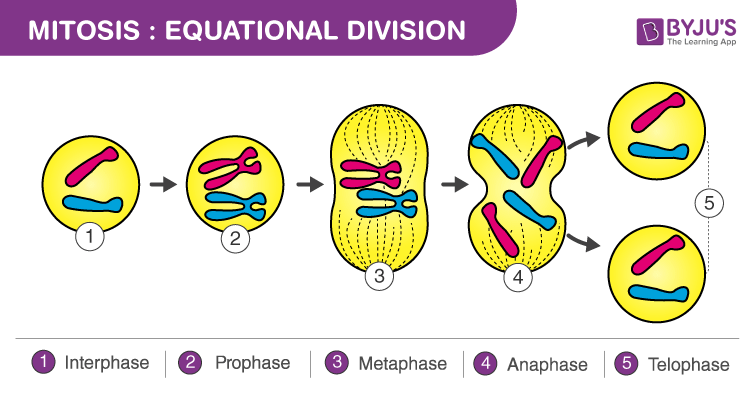
Mitosis Diagram showing the dissimilar stages of mitosis
Mitosis is the stage of the cell bike where the nucleus of a cell is divided into 2 nuclei with an equal corporeality of genetic material in both the daughter nuclei. It succeeds the G2 phase and is succeeded by cytoplasmic partition later the separation of the nucleus.
Mitosis is essential for the growth of the cells and the replacement of worn-out cells. Abnormalities during mitosis may modify the Dna, resulting in genetic disorders.
Features of Mitosis
- In each cycle of cell division, two daughter cells are formed from the parent jail cell.
- The prison cell is as well known every bit equational cell division because the chromosome number in the parent cell and girl cell is the same.
- In plants, mitosis leads to the growth of vegetative parts of the plant like root tip, stem tip, etc.
- Segregation and combination do not occur in this process.
The processes occurring during mitosis have been divided into different stages.
Stages of Mitosis
Correct earlier prophase, the prison cell spends most of its life in the interphase, where preparations are made earlier the beginning of mitosis (the Dna is copied). Nevertheless, since the actual procedure involves the partitioning of the nucleus, prophase is technically the first phase of this process.
The different stages of mitosis occurring during cell division are given equally follows-
Interphase
Before inbound mitosis, a jail cell spends a menstruation of its growth nether interphase. It undergoes the following phases when in interphase:
- G1 Phase:This is the catamenia before the synthesis of Deoxyribonucleic acid.
- S Phase:This is the stage during which Deoxyribonucleic acid synthesis takes place.
- G2 Phase:This is the phase between the cease of Dna synthesis and the beginning of prophase.
Prophase
Prophase immediately follows Southward and G2 phase of the cycle and is marked by condensation of the genetic material to course meaty mitotic chromosomes composed of two chromatids attached at the centromere.
The completion of prophase is characterised by the initiation of the associates of the mitotic spindle, the microtubules and the proteinaceous components of cytoplasm that help in the process.
The nuclear envelope starts disintegrating.
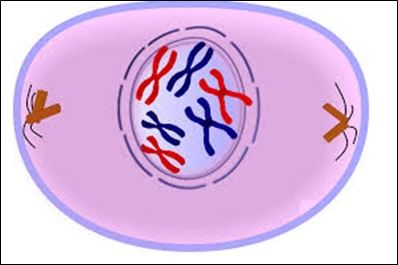
Prophase
Prometaphase
In the prometaphase, the nuclear envelop disintegrates. Now the microtubules are allowed to extend from the centromere to the chromosome. The microtubules adhere to the kinetochores which allow the jail cell to move the chromosome around.
Metaphase
At this phase, the microtubules first pulling the chromosomes with equal force and the chromosome ends upwardly in the middle of the cell. This region is known equally the metaphase plate. Thus, each cell gets an entire functioning genome.
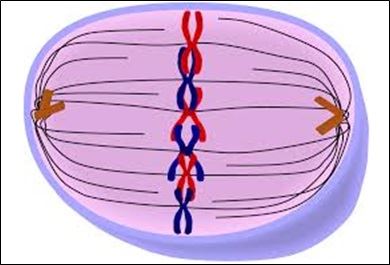
Metaphase
Anaphase
The splitting of the sister chromatids marks the onset of anaphase. These sis chromatids become the chromosome of the daughter nuclei. The chromosomes are then pulled towards the pole by the fibres attached to the kinetochores of each chromosome. The centromere of each chromosome leads at the edge while the artillery trail behind information technology.
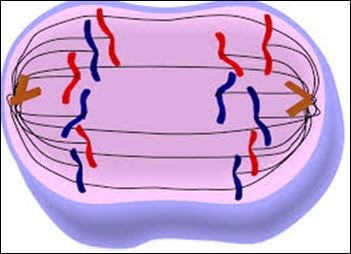
Anaphase
Telophase
The chromosomes that cluster at the two poles start coalescing into an undifferentiated mass, as the nuclear envelope starts forming around it. The nucleolus, Golgi bodies and ER circuitous, which had disappeared after prophase kickoff to reappear.
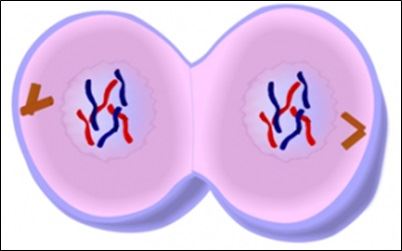
Telophase
Telophase is followed by cytokinesis, which denotes the division of the cytoplasm to form ii daughter cells. Thus, it marks the completion of cell partition.
Too Read: Cell Bicycle
Functions of Mitosis
Following are the ii important functions of mitosis:
- Mitosis helps in the development of an organism. In single-celled organisms, mitosis is the process of asexual reproduction.
- Mitosis helps in the replacement of damaged tissues. The cells near the damaged cells brainstorm mitosis when they do not sense the neighbouring cells. The dividing cells attain each other and encompass the damaged cells.
Significance of Mitosis
- Mitosis is responsible for the evolution of the zygote into an developed.
- Equal distribution of chromosomes to each daughter cell.
- Information technology is responsible for the growth and development of an individual.
- It maintains the constant number of chromosomes in all trunk cells of an organism.
- Mitosis is required for asexual reproduction, vegetative propagation in plants and likewise responsible for repair and regeneration of damaged tissues.
- Mitosis helps in maintaining purity of genome every bit no recombination or crossing over takes identify.
- It is responsible for repair and regeneration of former and damaged cells in animals e.g. gut epithelium, blood cells, etc.
Also Read:Deviation Between Mitosis And Meiosis
To know more about what is mitosis, stages of mitosis, its definition, mitosis diagram and other related topics, register at BYJU'South or download the BYJU'S app.
Too Read:Meiosis I & Meiosis II
Source: https://byjus.com/biology/mitosis/
 in mitosis allow this to occur?)
Post a Comment for "what mechanism(s) in mitosis allow this to occur?"