Do I Need Anti Glare on My Reading Glasses
Anti-Cogitating Coating for Eyeglasses
- Benefits of anti-reflective coating
- How anti-cogitating coating is applied
- Choose an AR coating that's best for you
- Caring for glasses with anti-reflective lenses
Benefits of anti-reflective coating
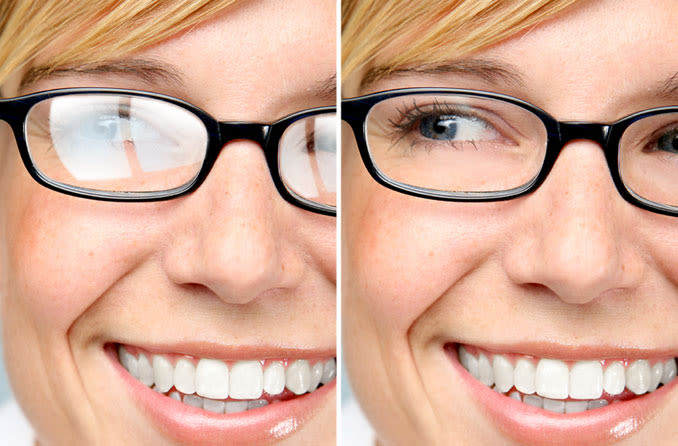
Anti-reflective coating (also called "AR coating" or "anti-glare blanket") improves vision, reduces eye strain and makes your eyeglasses look more bonny. These benefits are due to the power of AR blanket to virtually eliminate reflections from the front and back surfaces of your eyeglass lenses.
With reflections gone, more light passes through your lenses to optimize visual vigil with fewer distractions (especially at night), and the lenses look nearly invisible — which enhances your appearance by drawing more attention to your eyes and helping you make better eye contact with others.
AR coating is especially beneficial when used on high-index lenses, which reverberate more light than regular plastic lenses. Generally, the higher the alphabetize of refraction of the lens material, the more light that will be reflected from the surface of the lenses.
For example, regular plastic lenses reflect roughly viii% of calorie-free hitting the lenses, so only 92% of available light enters the eye for vision.
High alphabetize plastic lenses can reflect upwards to 50% more light than regular plastic lenses, so even less light is available to the eye for vision. This tin can be particularly troublesome in low-low-cal weather condition, such equally when driving at night.
Today's modern anti-reflective coatings tin virtually eliminate the reflection of light from eyeglass lenses, allowing 99.5% of bachelor light to pass through the lenses and enter the centre for good vision.
Past eliminating reflections, AR blanket also makes your eyeglass lenses wait nearly invisible and so people can meet your eyes and facial expressions more conspicuously. Anti-reflective spectacles also are more than attractive, so yous can wait your best in all lighting weather condition.
The visual benefits of lenses with anti-reflective coating include sharper vision with less glare when driving at dark and greater comfort during prolonged computer use (compared with wearing eyeglass lenses without AR coating).
When applied to photochromic lenses, AR blanket enhances the clarity and condolement of these premium lenses in all lite conditions without reducing their sun-reactive performance.
Anti-cogitating coating also is a good idea for sunglasses. It eliminates glare from sunlight reflecting into your eyes from the back surface of tinted lenses when the lord's day is behind you. (Generally, AR blanket is applied merely to the back surface of sunglass lenses because in that location are no corrective or visual benefits to eliminating reflections from the front surface of dark-tinted lenses.)
Most premium AR lenses include a surface treatment that seals the anti-reflective layers and makes the lenses easier to clean. These hydrophobic surface treatments also repel h2o, preventing the germination of water spots on your lenses.
Some anti-cogitating lenses have surface treatments that are both hydrophobic and oleophobic (also chosen lipophobic), which ways they repel both h2o and oil. These combination treatments typically incorporate fluorinated materials that give the lenses properties that are very similar to those of nonstick cookware.
How anti-reflective coating is applied
Applying anti-cogitating coating to eyeglass lenses is a highly technical process involving vacuum deposition technology.
The kickoff step in the AR coating process is to meticulously clean the lenses and inspect them for visible and microscopic surface defects. Fifty-fifty a tiny smudge, piece of lint or hairline scratch on a lens during the blanket process can cause a defective AR blanket.
Modern vacuum coating auto for applying AR blanket to eyeglass lenses. (Image: SatisLoh)
Typically, a production line includes multiple washing and rinsing baths, including ultrasonic cleaning to remove whatever traces of surface contaminants. This is followed by air drying and heating of the lenses in special ovens to further remove unwanted moisture and gases from the lens surface.
The lenses are and then loaded into special metallic racks with spring-loaded openings so the lenses are held deeply but with virtually all lens surfaces exposed for the coating application. The racks are and then loaded into the blanket bedroom. The door of the bedchamber is sealed, and the air is pumped out of the chamber to create a vacuum.
While the lens racks are rotating in the coating bedchamber, a power source within the automobile focuses a beam of electrons onto a small crucible that contains a series of metal oxides in separate compartments.
When the coating materials are bombarded by electrons, they vaporize within the blanket chamber and attach to the surfaces of the lenses — creating a uniform, microscopically thin optical layer on the lens.
Some eyeglass lenses have factory-practical AR blanket on both lens surfaces. Other lenses, particularly progressive lenses and other multifocal lenses (bifocals and trifocals), have the coating practical after the lenses have been customized to your eyeglass prescription by an optical lab.
Cull an AR coating that's best for you
Each AR coating manufacturer has its ain proprietary formula, simply generally all anti-reflective coatings consist of multiple microscopic layers of metallic oxides of alternating high and low index of refraction. Since each layer affects dissimilar wavelengths of light, the more layers at that place are, the more reflections that are neutralized. Some high-quality AR coatings accept up to seven layers.
Depending on your lifestyle, your optician might suggest a specific make of anti-reflective coating. If you spend a lot of time working at a calculator, you might benefit from an AR coating that filters out blue low-cal (case: Essilor's Crizal Prevencia).
Depending on the AR coating formula, virtually lenses with anti-reflective blanket accept a very faint residual color, usually green or blue, that is characteristic of that particular brand of coating.
Anti-reflective coatings are incredibly thin. The entire multilayer AR coating stack mostly is only most 0.two to 0.3 microns thick, or about 0.02 percent (2 ane-hundredths of 1 per centum) of the thickness of a standard eyeglass lens.
Run into Too: How To Clean Glasses — Without Scratching Your Lenses!
Caring for glasses with anti-reflective lenses
When cleaning AR-coated lenses, use but products that your optician recommends. Lens cleaners with harsh chemicals may impairment the anti-reflective coating.
Besides, don't attempt to make clean AR-coated lenses without wetting them offset. Using a dry cloth on a dry lens can cause lens scratches. And considering anti-reflective coating eliminates lite reflections that tin mask lens surface defects, fine scratches often are more visible on AR-coated lenses than on uncoated lenses.
Page published in February 2019
Page updated in January 2022
Source: https://www.allaboutvision.com/lenses/anti-reflective.htm

Post a Comment for "Do I Need Anti Glare on My Reading Glasses"